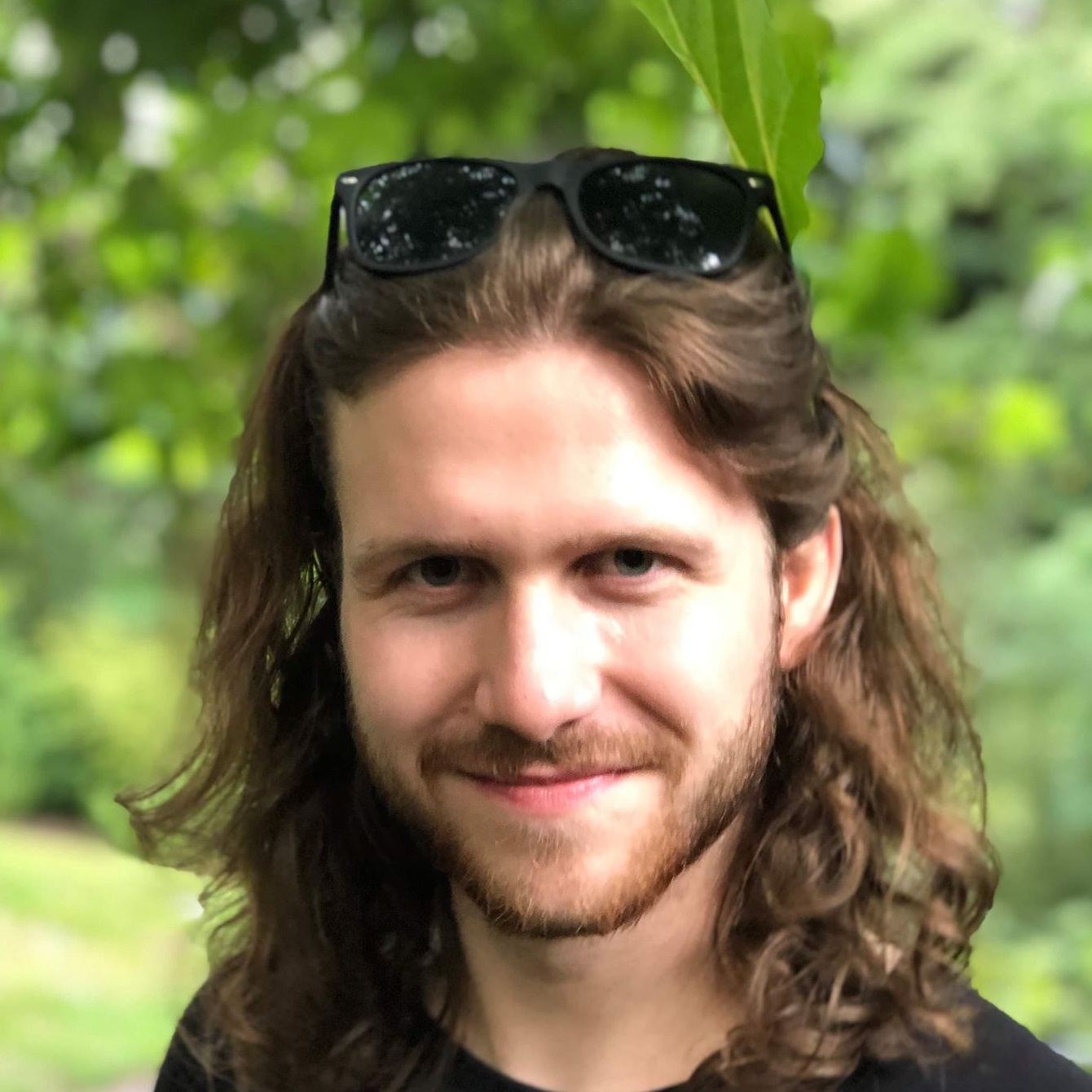
Roan Haggar

I'm a Postdoctoral Fellow working in the Waterloo Centre for Astrophysics (WCA) at the University of Waterloo. My research focuses on cosmological simulations of galaxy groups and clusters.

As well as research, I am involved in science outreach: I lead the astronomy outreach at the WCA, which includes running planetarium shows, stargazing nights, and public events.

My Research
Roan Haggar

Roan Haggar

Postdoctoral Fellow

University of Waterloo

Research

My research involves using cosmological simulations to probe the evolution of galaxies, groups and clusters. Some areas I am particularly focused on include:

In particular, I spend a lot of my time thinking about the dynamics of galaxy clusters and large-scale structures; I am heavily involved in The Three Hundred collaboration, and lead the collaboration's Cluster Dynamics science working group.

I'm also interested in pretty much anything related to the evolution of galaxies! I recently played a leading role on the organising committee for the Galaxy Evolution and Environment in Southern and Eastern Ontario (GEESE-ON) conference, hosted at the University of Waterloo.

Click for more details

Galaxy cluster dynamics

Galaxy cluster dynamics

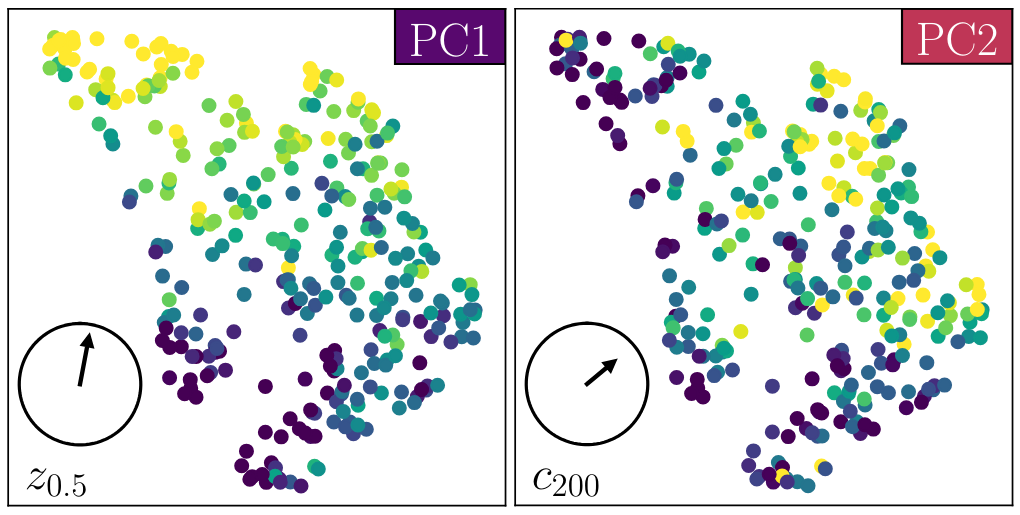
Galaxy clusters are often split into early-forming 'dynamically relaxed' clusters, and recently-forming 'dynamically disturbed' clusters. However, we found in Haggar et al. (2024a) that dynamical states are actually more complicated than this. Using PCA and UMAP, we show that dynamical state varies along multiple axes, meaning it is important to specify the sense in which a cluster is 'dynamically relaxed'.

Dynamical State

UMAP embedding of galaxy clusters, showing how only some (not all) recently-forming clusters have low-concentration dark matter haloes.

Backsplash galaxies

Backsplash galaxies

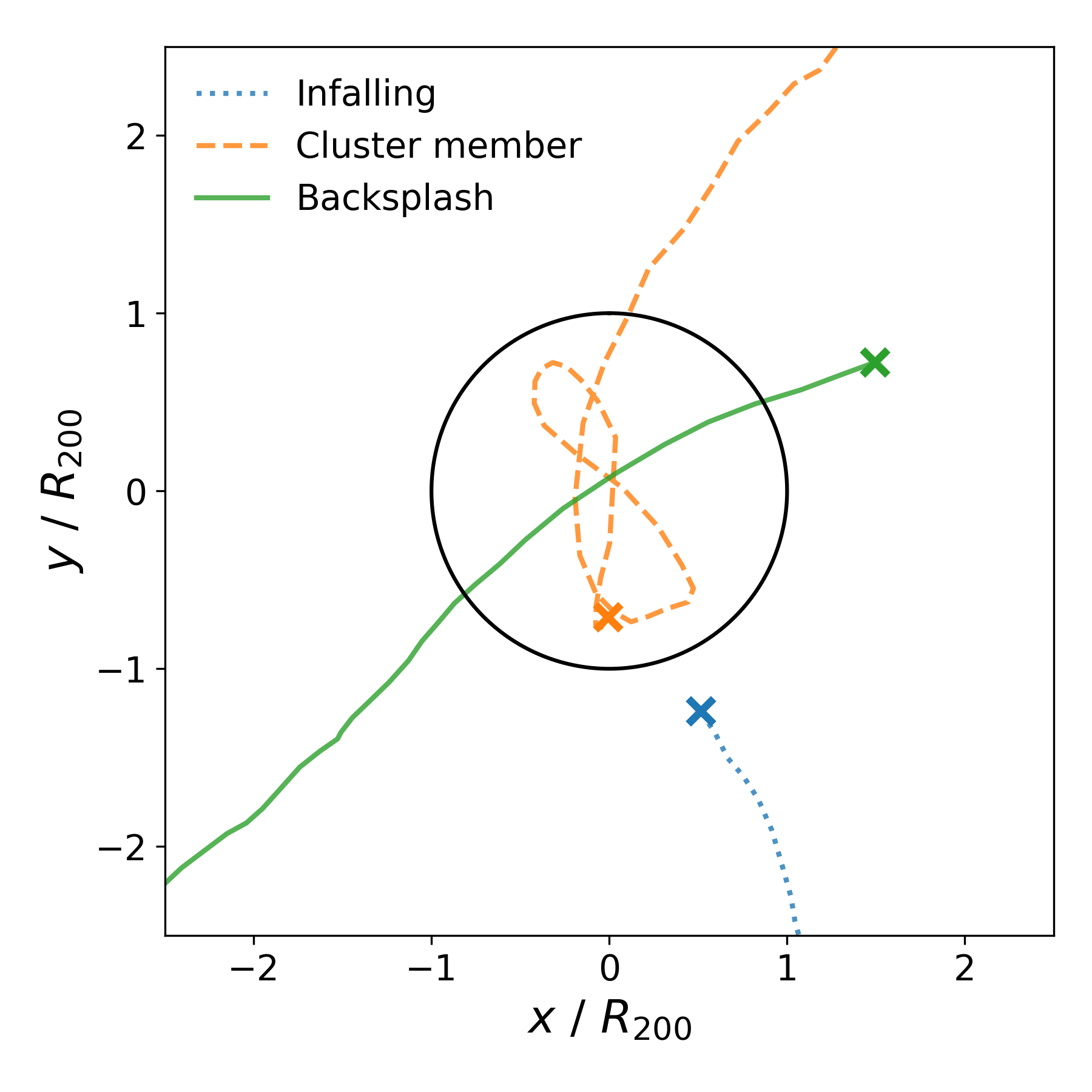
'Backsplash galaxies' have passed through a galaxy cluster in the past, but today are located beyond the cluster's radius. Consequently, they act as a contaminant when studying the effect of environment on galaxy evolution. In Haggar et al. (2020), we showed that the fraction of backsplash galaxies around a cluster varies with the dynamical state of the cluster; the dynamical state can be measured observationally, allowing us to predict the prevalence of backsplash galaxies around an individual cluster.

Backsplash Galaxies

Paths of an infalling galaxy, cluster member and backsplash galaxy, taken from simulations. Black circle shows the radius of the cluster, and crosses show galaxy positions at z = 0.

Infalling galaxy groups

Infalling galaxy groups

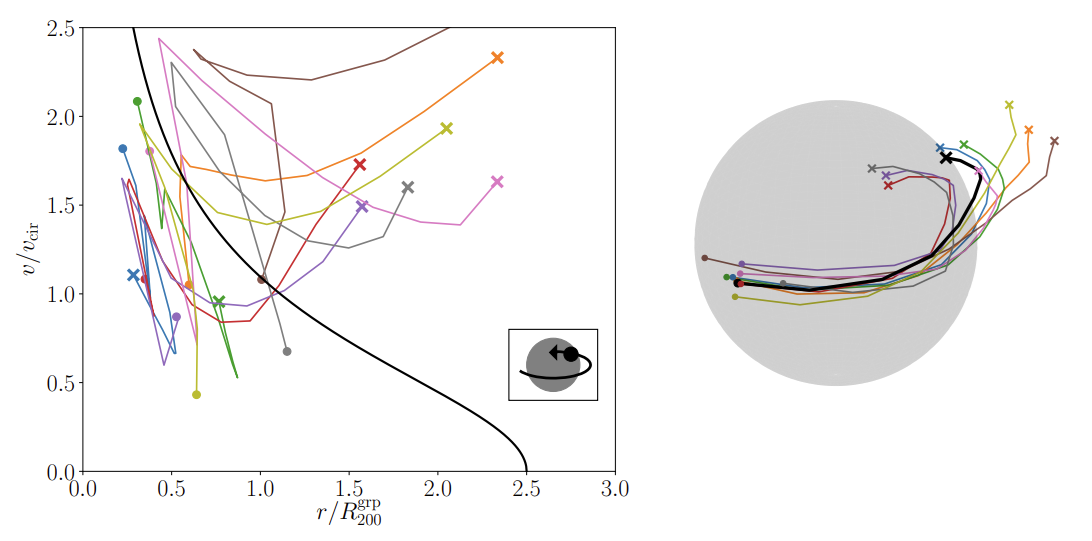
Clusters can grow by accreting smaller groups of galaxies, but in Haggar et al. (2023) we used hydrodynamical simulations to show that groups are very quickly tidally disrupted when approaching a cluster. This means that any groups observed nearby to a cluster are almost certainly on their first approach. We also showed that galaxies in different parts of these groups undergo different processes, such as tidal stripping and mergers. Hydrodynamical simulations, as opposed to dark matter-only simulations, are crucial for studying these processes, as we showed in Haggar et al. (2021).

Infalling Groups

Paths of a typical galaxy group passing through a large cluster. Left panel shows the varying group-centric positions and velocities of the group members during the passage through a cluster; galaxies that were bound to the group (below the black line) quickly move above the line and become unbound.

Cosmology

Cosmology

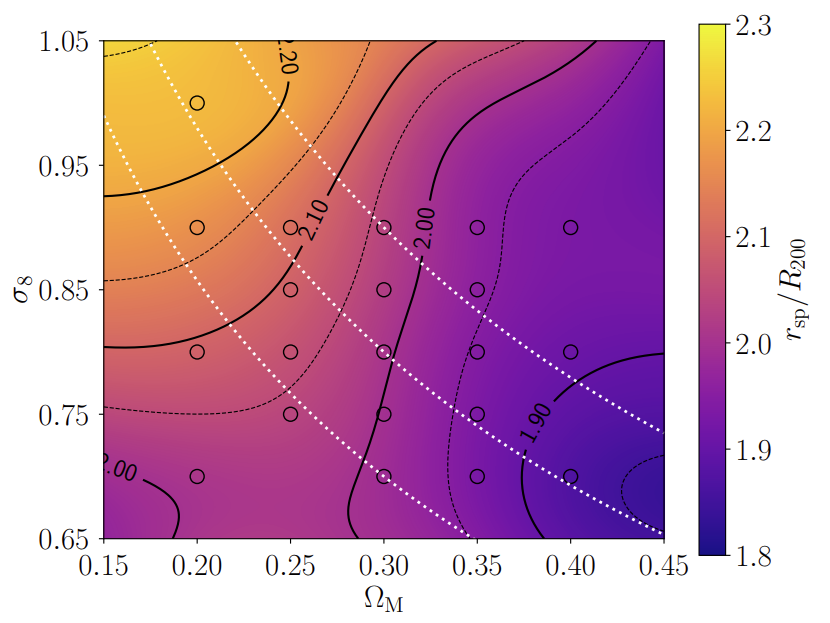
In Haggar et al. (2024b), we showed that the average splashback radius of galaxy clusters varies with the cosmological parameters ΩM and σ8, as variations in these parameters impact the average formation time of dark matter haloes. Measurements of the splashback radius therefore provide a cosmological test, which is mostly independent of existing methods.

Cosmology

Variation in the splashback radius with cosmological parameters; note that the contours are almost perpendicular to the highly-degenerate single-redshift measurements of S8, shown by the white contours.

Publications

19 peer-reviewed publications | 5 as first author

2025
Contreras-Santos A., Knebe A., Cui W., Alonso Asensio I., Dalla Vecchia C., Haggar R., Mostoghiu Paun R. A., Pearce F. R., Rasia E., Martin G., Nuza S. E., Yepes G., The origin of the intra-cluster light in The Three Hundred simulations, A&A, 703, A85
2025
Mpetha C. T., Taylor J. E., Amoura Y., Haggar R., de Boer T., Guerrini S., Guinot A., Hervas Peters F., Hildebrandt H., Hudson M. J., Kilbinger M., Liaudat T., McConnachie A., Van Waerbeke L., Wittje A., Cosmology from UNIONS weak lensing profiles of galaxy clusters, MNRAS, 543, 1393
2025
Onions J., Pearce F., Knebe A., Gray M., Haggar R., Kuchner U., Contreras-Santos A., Yepes G., Cui W., The life and times of dark matter haloes: what will I be when I grow up?, MNRAS, 542, 1477
2024
Haggar R., Amoura Y., Mpetha C. T., Taylor J. E., Walker K., Power C., Constraining cosmological parameters using the splashback radius of galaxy clusters, ApJ, 972, 28
2024
Mpetha C. T., Taylor J. E., Amoura Y., Haggar R., The infall region as a complementary probe to cluster abundance, MNRAS, 532, 2521
2024
Haggar R., De Luca F., De Petris M., Sazonova E., Taylor J. E., Knebe A., Gray M. E., Pearce F. R., Contreras-Santos A., Cui W., Kuchner U., Mostoghiu Paun R. A., Power C., Reconsidering the dynamical states of galaxy clusters using PCA and UMAP, MNRAS, 532, 1031

View full publication list on ADS →

Academic Talks

Conference Talks

Feb. 2026
PRIN 2022 Meeting: Mass and Selection Biases of Galaxy Clusters, online meeting
Cluster dynamical states with dimensionality reduction
Oct. 2025
Galaxy Evolution and Environment in Southern and Eastern Ontario, Waterloo, ON, Canada
Identifying backsplash galaxies using machine learning
Jul. 2025
National Astronomy Meeting 2025, Durham, UK
Identifying backsplash galaxies using machine learning

Talks at Academic Institutions

Mar. 2024
Tata Institute of Fundamental Research, Mumbai, India (online talk)
Cosmology and galaxy evolution in the outskirts of galaxy clusters
Oct. 2022
Waterloo Centre for Astrophysics, University of Waterloo, Waterloo, ON, Canada
Simulations of galaxy groups and galaxy clusters
Feb. 2022
Kavli Institute for Astrophysics and Space Research, MIT, Cambridge, MA, USA (online talk)
Backsplash galaxies and galaxy groups in the outskirts of clusters

Posters & Other Presentations

Oct. 2025
Galaxy Evolution and Environment in Southern and Eastern Ontario, Waterloo, ON, Canada
Organising committee member & breakout session organiser
Aug. 2025
Galaxy Memoirs, Buzíos, Brazil
Identifying backsplash galaxies with machine learning, poster
Jul. 2025
'The Three Hundred' Annual Collaboration Meeting, Trim, Ireland
Dynamical state, session chair

Science Outreach

Click for more details:

Astro-Bubble

Astro-Bubble

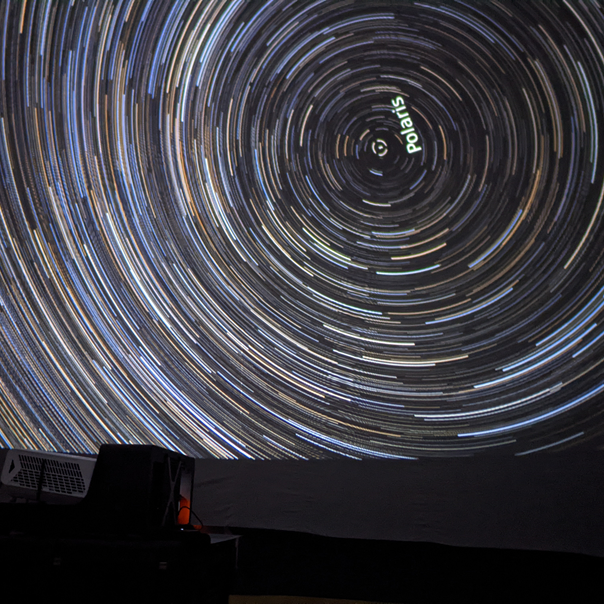
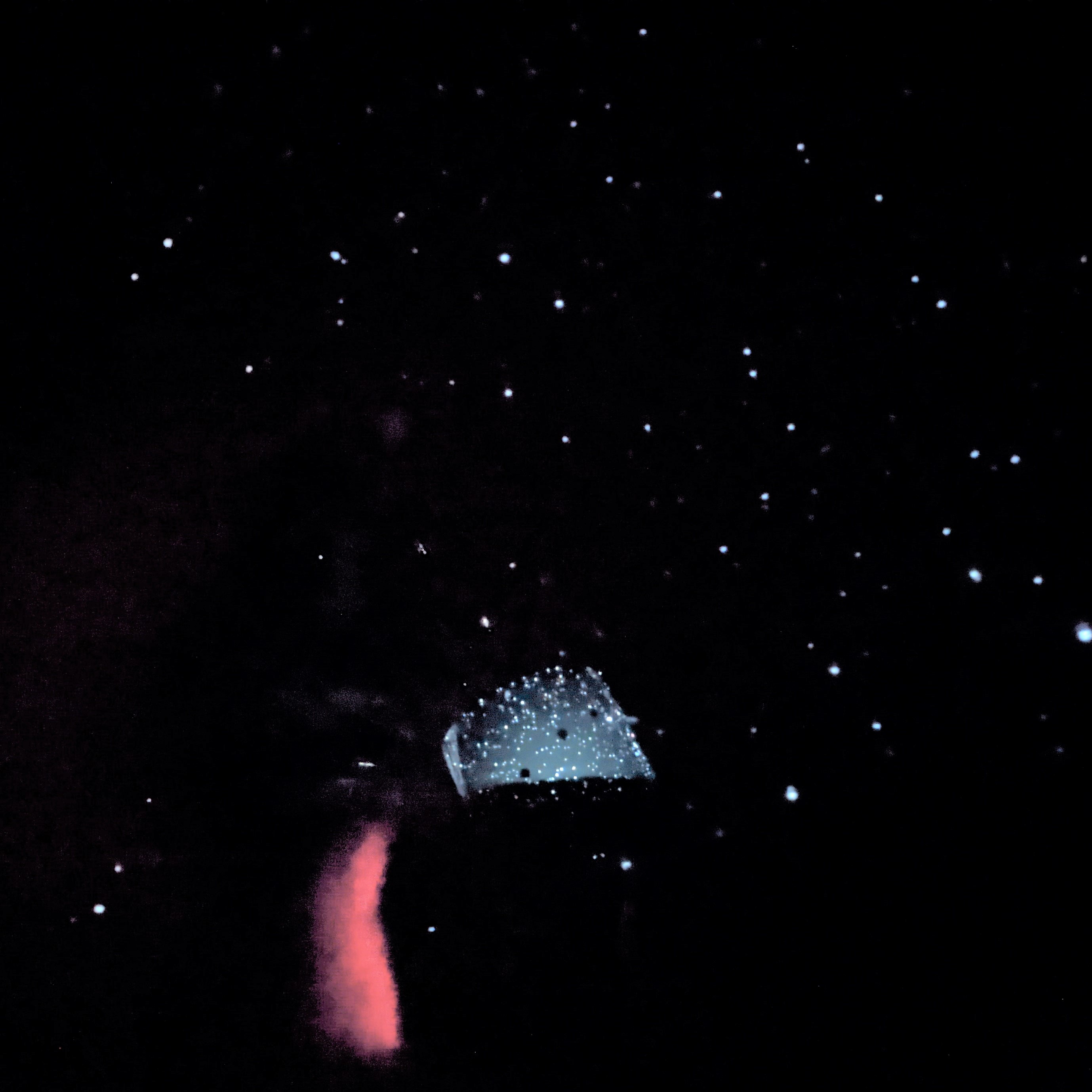
I oversee the Astro-Bubble programme in the Waterloo Centre for Astrophysics, organising visits with this portable planetarium to local schools, summer camps and Guides/Scouts groups. I also design other astronomy-related activities to support the planetarium, on topics like planets, galaxy evolution, and solar eclipses.

Astronomy on Tap

Astronomy on Tap

Astronomy on Tap is a series of monthly events that take place worldwide in bars and pubs, designed to share astronomy in a fun, relaxed, informal environment. I run the Kitchener-Waterloo branch of Astronomy on Tap, organising regular public astronomy nights with guest speakers.

WCA-KPL Talks

WCA-KPL Talks

I also founded and oversee the monthly WCA-KPL seminar series, organised by the Waterloo Centre for Astrophysics and hosted at Kitchener Public Library. These public talks aim to share the world-leading research taking place in Waterloo with the local community, in a free and accessible way.

Astrobites

Astrobites

From 2021 to 2023 I was a regular contributing author for Astrobites, an online journal that publishes short articles summarising contemporary astronomy research in accessible language. In 2021 I also represented Astrobites at the National Astronomy Meeting, where I presented a poster promoting the work of Astrobites.

You can find a full list of my articles here.

Inflativerse

Inflativerse

For three years during my PhD I co-managed the University of Nottingham's Inflativerse planetarium, running visits to local schools, with a particular focus on those in underprivileged areas of Nottingham. I also helped to develop a new range of astronomy-based activities when in-person planetarium shows were not possible, which subsequently allowed us to permanently expand this outreach programme.

I'm a Scientist

I'm a Scientist

I'm a Scientist is an online outreach activity that runs several times a year, and puts school students in contact with scientists, giving them the opportunity to ask questions about science and higher education. I participated in the scheme on multiple occasions during my PhD studies.

Public Talks

Feb. 2026
Astronomy on Tap, Kitchener, ON, Canada
Galaxy clusters: The biggest things in the Universe
Dec. 2025
Kitchener-Waterloo Royal Astronomical Society, Waterloo, ON, Canada
The darkest matter in the Universe
Oct. 2025
University of Waterloo PHYS10 Seminar Series, Waterloo, ON, Canada
The Universe in a computer

Media Appearances

Nov. 2025
CTV Kitchener — TV appearance discussing aurora borealis
Oct. 2025
CBC Kitchener-Waterloo — Radio interview about supermoons and meteor showers
Mar. 2025
CTV Kitchener — TV appearance discussing total lunar eclipse

About Me

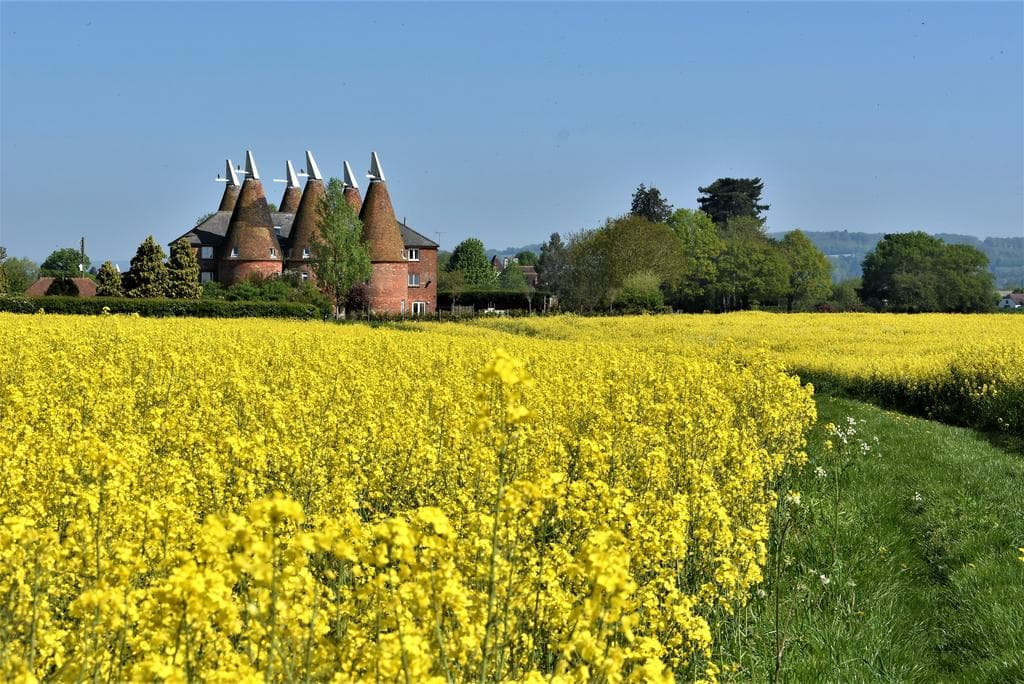
Kent countryside

I was born and grew up in Kent, UK, known as the 'Garden of England' because of its lovely countryside (see picture). I studied at Durham University (MPhys, 2018) and the University of Nottingham (PhD, 2022), and since 2022 have been a Postdoctoral Fellow at the University of Waterloo.

My research mainly focuses on simulations of galaxy clusters. I am particularly interested in cluster dynamics, the evolution of infalling galaxies and groups, and connecting these to large-scale structure and galaxy evolution. I am involved with The Three Hundred project, a large catalogue of galaxy clusters, simulated with multiple physics models.

Outside of astronomy, I spend my time rock climbing (mostly indoors) and listening to music (mostly from the 1990s), so please talk to me about either of these! I also have a strong interest in science outreach; I lead the public outreach efforts from the Waterloo Centre for Astrophysics, regularly communicating astrophysics to the public through talks, writing, and media appearances.

Image credit: 'Oast houses in the Kent countryside' (MelaQuin, Deviant Art)

Get in Touch

Institution

Waterloo Centre for Astrophysics
University of Waterloo
Waterloo, Ontario, Canada